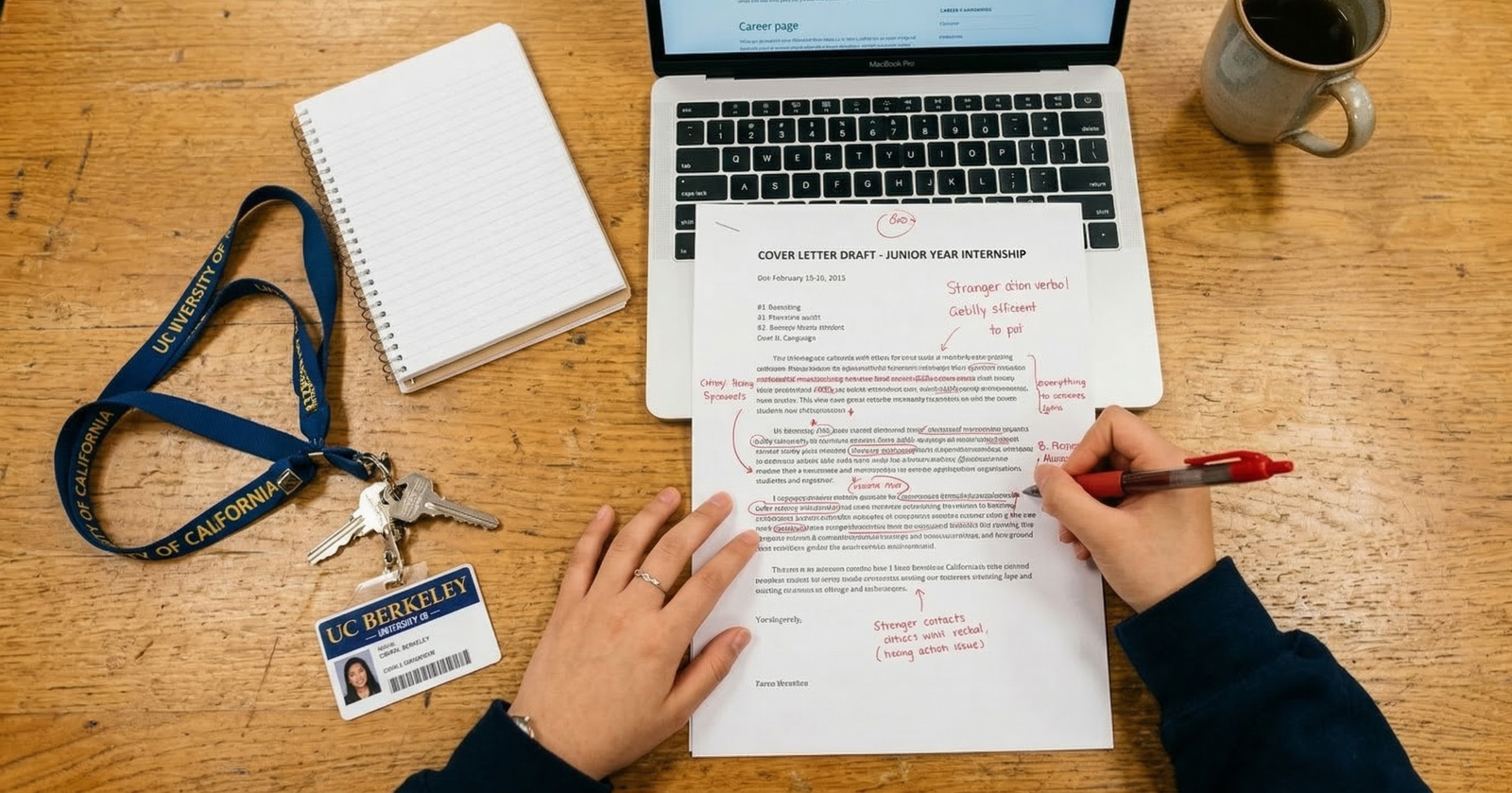
How to Write a Cover Letter for an Internship (With 6 Industry Examples)
TL;DR
• A cover letter for an internship should run 250-400 words, be written for the specific company and role, and open with your strongest experience or project. According to a 2026 ResumeGenius survey, 83% of hiring managers read cover letters and 94% say they influence who gets an interview.
• Below you'll find a "Do I even need one?" decision framework, the four-part structure recruiters actually want, and an honest look at when ChatGPT helps vs. hurts.
• We include 6 full cover letter examples for finance, tech, data analytics, marketing, consulting, and a no-experience scenario.
• You'll also get a modern "cover email" template, tips for framing non-traditional experience like Externships, and answers to the seven most common cover letter questions.
Externships are short, remote professional experience programs where you work on real projects with real companies. An Externship in data analytics with Beats by Dre, product innovation with BeReal, or healthcare data analytics with TruBridge gives you portfolio-ready experience to talk about in your cover letter. Explore all Externships.
Do You Actually Need a Cover Letter for an Internship?
Short answer: yes, almost always. Even when the application marks the cover letter field as "optional," submitting one puts you ahead of everyone who skips it. The real question is how much effort to invest, and that depends on the type of company.
When a Cover Letter Is Required vs. Optional
A cover letter for an internship is a one-page document that introduces you to a hiring manager, explains why you want this particular role, and highlights experience your resume can't fully capture. It's your chance to tell a story that bullet points won't tell.
, 83% of hiring managers read cover letters and 94% say they influence interview decisions. That's a big number.
And here's the part that might surprise you: 82% of those same managers say a strong letter can actually rescue an otherwise weak application.
So when is it truly optional? If you're hitting a quick-apply button on LinkedIn or Indeed and there's literally no upload field, don't force it.
But if there's a spot to attach one, take the five minutes. It could be the difference between landing an interview and getting filtered out.
And once you do get that interview, you'll want to be ready with the right interview prep strategy.
The Company-Size Decision Framework
Not all companies weigh cover letters the same way. Here's a rough guide:
| Company Type | Size | Cover Letter Needed? | Why |
|---|---|---|---|
| Startup | Under 50 | Yes, always | Small teams read every application; personalization matters most here |
| Mid-size | 50–500 | Depends on role | Creative/client-facing roles expect it; engineering roles may not require it but it helps |
| Fortune 500 | 500+ | Yes, if portal allows | ATS parses for keywords; feeds into application score even if human reads it later |
| Government / Nonprofit | Any | Yes, always | Traditional hiring processes; skipping signals lack of attention to detail |
Startups (under 50 employees): Cover letters matter a lot here. Smaller teams read every single application, and founders often review resumes themselves. So a letter that shows you actually understand their product can set you apart from dozens of generic applicants who just blasted the same PDF everywhere.
Mid-size companies (50-500 employees): Depends heavily on the role. Creative positions, client-facing roles, and communications jobs almost always expect one. Engineering or data roles at mid-size companies might not technically require it, but submitting one still helps your odds.
Fortune 500 companies: Many large companies use applicant tracking systems (ATS) that parse cover letters for keywords. Your letter may not reach a human first, but it absolutely feeds into your overall application score. Include one whenever the portal gives you the option.
Government and nonprofits: Always submit a cover letter. These organizations follow more traditional hiring processes, and skipping the letter can signal carelessness.
What Should a Cover Letter for an Internship Include?
Your cover letter needs to answer three questions for the reader: Who are you? Why this company? And what can you actually bring to the team? You've got roughly 250-400 words to pull that off. Not a lot of room.
The 4-Part Structure That Hiring Managers Expect
Here's the structure that works for most internship applications:
1. The Hook (2-3 sentences): Open with something specific. A result you achieved, a connection to the company, or a question that shows genuine curiosity. Skip "I am writing to apply for..." entirely.
2. Why This Company (2-3 sentences): Name something real about the company that attracted you. A recent product launch, a value from their website, a project you admire. Vague flattery like "I've always admired your company's innovation" won't cut it.
3. Your Relevant Experience (4-6 sentences): This is the heart of your letter. Pick 1-2 experiences and explain what you did, what skills you used, and what came of it. Numbers help: "increased social media engagement by 34%" beats "helped with social media" every time.
4. The Close (2-3 sentences): End with a clear next step. Be direct: "I'd love to discuss how my experience with [X] could contribute to [team/project]. I'm available for an interview at your convenience." Don't grovel. Don't posture. Just ask.
How Long Should an Internship Cover Letter Be?
Between 250 and 400 words. That's roughly half a page with standard formatting (11-12 point font, 1-inch margins).
A 2026 Jobvite recruiter survey found that 250-word cover letters had a 53% higher callback rate than letters over 500 words. Most recruiters spend 30-60 seconds on a cover letter before deciding whether to keep going. Under 200 words looks dismissive. Over 500 almost guarantees nobody reads the whole thing.
Need help building the resume that goes alongside this letter? Check out these resume examples for college students.
How to Start a Cover Letter for an Internship (First Paragraph Examples)
Your first two sentences decide whether someone keeps reading. That's it. Hiring managers review hundreds of applications per opening, and they've seen every version of "I am excited to apply" that exists. So your opener needs to give them a real reason to slow down.
3 Opening Lines That Get Read
Three approaches that consistently land:
1. Lead with a specific result.
"During a market analysis project for my business analytics course at NYU, I identified a pricing gap that my professor called 'the most actionable student insight in three years.' That experience confirmed that I want to build a career in data-driven strategy, which is exactly what your summer analyst program offers."
This works because it opens with proof, not promises.
2. Lead with a company connection.
"When Spotify launched its AI DJ feature last year, I spent three hours testing it and wrote a 1,200-word product review on my blog. Your product team's approach to personalization is the reason I'm applying for the product management internship."
This works because it proves genuine interest. The applicant didn't just Google the company five minutes before hitting submit.
3. Lead with a question that shows curiosity.
"How does a 15-person marketing team generate 4x the social engagement of competitors with 200-person departments? That's the question that drew me to your internship posting, and it's the kind of problem I want to help solve."
This one's riskier.
But when it hits, it hits. It shows research and signals that you think about the business, not just the resume line.
What to Avoid in Your Opening
"I am writing to apply for the [position] at [company]." The hiring manager already knows this. You're wasting your best real estate on information the subject line already provides.
Save this for paragraph two. Lead with what you've actually done and what you can bring to the team.
Yet so many applicants open with their class year like it's breaking news. It's not.
"I have always been passionate about [industry]." Passion without evidence is just a word. Show what you've actually done instead of telling them what you feel deep inside your heart or whatever.
Should You Use ChatGPT to Write Your Cover Letter?
This is probably the most common question students have about cover letters in 2026. And the honest answer is: it depends entirely on how you use it.
The AI Hybrid Workflow (When to Use It, When Not To)
About 29.3% of job seekers used AI to write or customize applications in 2025, up from 17.3% in 2024. That number keeps climbing. But here's the problem: roughly 74% of hiring professionals say they can spot AI-generated text, and a 2025 TopResume survey found that 19.6% of hiring managers would reject a candidate they believed used AI for their entire application.
So should you use it? Here's my honest take:
When AI helps:
• Outlining your letter structure
• Brainstorming which experiences to highlight
• Checking grammar and tone
• Getting past the blank-page problem when you're stuck
When AI hurts:
• Writing the entire letter from scratch and submitting it unedited
• Using lazy prompts like "write me a cover letter for a marketing internship"
• Skipping personalization (company-specific details, your actual numbers)
• Sending the first draft it produces
The real risk isn't that someone runs your letter through a detector tool. It's that your letter sounds exactly like every other AI-generated letter in the pile. Same structure, same vague enthusiasm, same buzzwords. Sound familiar? For a deeper breakdown of using AI the right way, read our guide on ChatGPT cover letters.
How to Edit an AI Draft So It Sounds Like You
If you start with a ChatGPT draft (and honestly, that's fine), run through these four edits before you submit:
1. Add your specific numbers. Replace "I contributed to a marketing campaign" with "I managed the Instagram content calendar for a campus club and grew followers from 340 to 1,200 in one semester."
2. Kill the generic phrases. Search for words like "passionate," "driven," "innovative," and "results-oriented." If ChatGPT wrote them, delete them. Say the actual thing in plain language.
3. Drop in company-specific details. Mention a real product, a recent news article, or a team member's work that got your attention. This is what AI can't do well without you.
4. Read it out loud. If any sentence sounds like a robot giving a speech at a career fair, rewrite it. Your letter should sound like you talking to a recruiter over coffee, not a press release.
How to Write a Cover Letter With No Experience
This is where most students get stuck. You open a blank document, stare at it, and think: "I literally have nothing to write about."
That's almost never true. You have more relevant experience than you realize.
Yet most students don't see it because it doesn't look like a "real job." You just need to frame it differently.
Framing Externships, Projects, and Hackathons as Real Experience
Traditional internships aren't the only experience that matters on a cover letter. And this is something a lot of students don't realize. Employers at Goldman Sachs, Google, McKinsey, and hundreds of smaller companies regularly hire candidates whose strongest experience comes from class projects, Externships, hackathons, or independent research.
The difference is in how you describe it. Look at this before-and-after:
Before (weak): "I completed a data analytics Externship where I learned about SQL and data visualization."
After (strong): "During a data analytics Externship with TruBridge, I built a patient scheduling dashboard in Tableau that identified a 12% gap in appointment utilization, presenting my findings to the company's VP of Operations."
The second version names the company, specifies the deliverable, puts a number on the result, and mentions who actually saw the work.
And that's exactly what hiring managers want to read.
Not sure which skills to highlight on your resume and cover letter? Start with the ones that match the job description word for word.
The "Transferable Skills" Approach
What if you genuinely don't have any project-based experience yet? You can still write a solid cover letter by connecting transferable skills to the job description.
Here's the process:
1. Identify the skill. Read the posting and pick 2-3 skills they name (e.g., "attention to detail," "teamwork," "data analysis").
2. Match it to something you've actually done. It absolutely doesn't have to be a paid job. Organizing a 200-person campus event? That shows project management and stakeholder coordination. Tutoring younger students for two semesters straight proves you can communicate complex ideas clearly. Running a fantasy sports league with weekly analytics writeups counts as data analysis. Seriously.
3. Write a STAR-format sentence. Situation, Task, Action, Result. "As treasurer of the Economics Club, I restructured our sponsorship outreach, secured three new sponsors, and increased our annual budget by 40%."
I said framing non-traditional experience sounds easy. It's not, really. Your first attempt at writing one of these sentences will probably feel painfully awkward.
But the goal is to show you can do the work, even if you haven't done it in a formal setting.
And if you want to build real project experience before applications open, an
Internship Cover Letter Examples by Industry
Reading about structure is useful, but seeing full examples is way better. Below are six complete cover letter examples for different industries. Each one is formatted as a real letter and shows how to adjust your writing for a specific field.
Use these as inspiration. Don't copy them word-for-word.
Cover Letter for Finance Internship (Investment Banking Example)
Dear Ms. Chen,
When JPMorgan's latest Global Markets report projected a 15% increase in M&A activity for 2026, I spent my weekend building a comparable deal analysis spreadsheet to test the thesis against mid-cap transactions from the past three years. That kind of curiosity is what drives me to apply for the Summer Analyst position in your Investment Banking Division.
As a junior at the University of Michigan studying finance and statistics, I've built a solid foundation in financial modeling and valuation. During a financial modeling Externship, I constructed a three-statement model for a Series B startup and presented a valuation range to the managing partner. In my investments course, I managed a $50,000 portfolio in our student fund, returning 8.2% over one semester against a benchmark of 5.1%.
I'm drawn to JPMorgan's technology-focused deals and would welcome the opportunity to discuss how my modeling skills and market curiosity could contribute to your team. I'm available for an interview at your convenience.
Sincerely,
Alex Rivera
Cover Letter for Tech Internship (Software Engineering Example)
Dear Hiring Team,
Last semester, I noticed that my university's course registration system crashed during peak enrollment every single time. So I built a prototype load-balancing solution using Node.js and Redis, documented it on GitHub, and shared it with the IT department. They're piloting it this fall. That hands-on approach is what I'd bring to the Software Engineering Intern role at Stripe.
I'm a computer science junior at Georgia Tech with experience in Python, JavaScript, TypeScript, and SQL. Through an AI agent engineering Externship with Wayfair, I developed an automated data pipeline that reduced manual reporting time by 60%. I've also contributed to two open-source projects on GitHub and placed second in HackGT's 2025 hackathon with a budget-tracking app built in React.
Stripe's developer-first culture and API infrastructure fascinate me. I'd love to discuss how my backend engineering experience could support your team's work.
Best regards,
Priya Nguyen
Cover Letter for Data Analytics Internship (Full Example)
Dear Mr. Torres,
When I read that Procter & Gamble uses real-time demand sensing to adjust production across 180+ countries, I immediately wanted to understand the data models behind it. That curiosity is why I'm applying for the Data Analytics Intern position on your Consumer Insights team.
I'm a junior at the University of Texas at Austin studying information systems with a minor in statistics. During a healthcare data analytics Externship with TruBridge, I analyzed 18 months of patient scheduling data using SQL and Python, built predictive models for appointment no-shows, and created a Tableau dashboard the operations team used to improve scheduling accuracy by 9%. In my advanced analytics course, I completed a regression project on retail sales volume that my professor chose as one of three exemplary submissions.
P&G's data-driven culture is exactly where I want to learn and grow. I'd welcome the chance to discuss how my skills could contribute to your consumer insights work.
Sincerely,
Jordan Kim
Cover Letter for Marketing Internship (Full Example)
Dear Ms. Patel,
I grew our university's Student Activities Board Instagram from 800 followers to 3,400 in one semester by shifting from event flyers to behind-the-scenes Reels and student spotlights. That 325% growth taught me more about content strategy than any textbook, and it's the reason I'm applying for the Marketing Intern position at Glossier.
As a communications major at Boston University, I've paired creative instincts with data. During a creative strategy Externship with Beats by Dre, I developed a Gen Z audience segmentation framework and pitched a social campaign concept to the brand team. I also run a personal blog reviewing skincare products, which pulls in 12,000 monthly readers through organic SEO alone.
Glossier's community-driven approach is what originally made me a customer. Now I want to help build it. I'd love to discuss how my content creation skills and audience growth experience could strengthen your social strategy.
Best,
Mia Thompson
Cover Letter for Consulting Internship (Full Example)
Dear Ms. Williams,
At the Midwest Regional Case Competition in February, my team had 48 hours to develop a market entry strategy for a mid-size healthcare company expanding into telehealth. We won first place, and the judges specifically praised our financial sensitivity analysis. That structured problem-solving is what I want to bring to Deloitte's Summer Associate Analyst program.
I'm a junior at Northwestern University studying economics and data science. During a product innovation Externship with BeReal, I conducted a competitive analysis of seven social platforms and recommended three product features with projected user retention impact. In my econometrics course, I built a regression model analyzing how remote work policies affect commercial real estate occupancy in three Midwest metros.
Deloitte's technology-enabled consulting focus and healthcare practice growth match exactly where I want to build my career. I'd appreciate the chance to talk about how my analytical background could support your team.
Sincerely,
David Okafor
Internship Cover Letter With No Experience (Full Example)
Dear Hiring Team,
I don't have a traditional internship on my resume yet. What I do have is a portfolio of real projects that prove I can research, analyze, and communicate at a professional level.
I'm a sophomore at Arizona State University studying business administration. Through a supply chain Externship with Pfizer, I analyzed procurement data and built a cost optimization framework that the company's supply chain director reviewed. For a class project, I led a team of four in a market analysis of the plant-based food industry, delivering a 30-page report with five actionable recommendations. And as president of our campus Entrepreneurship Club, I organized a 150-person startup pitch competition, secured $5,000 in sponsorships, and managed a $3,200 event budget.
I know I'm earlier in my career than some applicants. But I learn fast, I take initiative, and every project I've taken on shows I can deliver. I'd welcome the chance to talk about how I could contribute this summer.
Sincerely,
Taylor Santos
Should You Send a Cover Email Instead of a Full Letter?
Here's something most cover letter guides skip: for a lot of real situations, a full cover letter isn't even the right format. If someone referred you, or you're emailing a recruiter directly, what you actually need is a cover email.
When to Use a Cover Email Instead of a Full Letter
A cover email is a shorter message (75-150 words) written in the body of an email, with your resume attached as a PDF. It's not a replacement for a formal cover letter on an application portal. Think of it as a totally different tool for a different situation.
| Feature | Full Cover Letter | Cover Email |
|---|---|---|
| Length | 250–400 words | 75–150 words |
| Format | PDF attachment | Email body text |
| When to use | Online portals, formal postings, government jobs | Referrals, direct recruiter emails, LinkedIn follow-ups |
| Tone | Professional, structured | Conversational, direct |
| Structure | 4 paragraphs (hook, company, experience, close) | 3–5 sentences (referral, background, ask) |
Full cover letter: Online application portals, formal job postings, government positions, any application with a cover letter upload field.
Cover email: Networking referrals ("Hi, Sarah Chen suggested I reach out"), direct recruiter emails, LinkedIn follow-ups, informal company applications with no portal.
The biggest difference? Length. A cover email should be 3-5 sentences in the email body. Not three paragraphs. The recruiter already knows why you're reaching out because someone told them. Your job is to be concise and attach your resume.
Cover Email Template You Can Copy
Here's a template that works for most referral situations:
Hi [First Name],
[Referrer's Name] suggested I reach out about the [Position] opening on your team. I'm a [year/major] at [University] with experience in [1-2 relevant skills/experiences]. [One specific sentence about why this role or company interests you.]
I've attached my resume and would love to chat about how I could contribute. Would any time this week or next work for a quick call?
Best,
[Your Name]
That's the whole thing. Short, direct, personalized enough to show you're a real human who did five minutes of research.
So don't overthink it.
What Are the Biggest Cover Letter Mistakes That Get You Rejected?
You can write a decent cover letter and still torpedo your application with avoidable mistakes. According to that same ResumeGenius 2026 survey, 51% of hiring managers say a weak cover letter can stop them from interviewing an otherwise strong candidate. More than half.
Generic Openers and Template Language
Here are the five most common mistakes and how to fix them:
1. Generic opener. "I am writing to apply for..." tells the reader absolutely nothing. Fix: open with a specific result, a company detail, or a question instead.
2. No company research. If you could swap the company name for literally any other company and the letter still works, it's too generic. Fix: mention a specific product, initiative, or recent news story that connects to why you want this role.
3. Too long. Over 400 words for an internship letter is just too much. Nobody's reading all of that. Fix: cut anything starting with "I believe" or "I am passionate about." Those phrases eat up space and say nothing concrete.
4. Formatting errors. Mismatched fonts, zero paragraph breaks, or a .docx file instead of a PDF. So many applications get dinged for this. Fix: use a clean template, save as PDF, and check how it renders on both desktop and mobile before you hit send.
5. No call to action. Ending with "Thank you for your consideration" and nothing else leaves the reader with nowhere to go. Fix: close with a specific ask. "I'd love to discuss how my [skill] could contribute to [project]. I'm available for an interview at your convenience."
If you're getting ready for the interviews that follow a strong cover letter, practice with mock interview tools so you're not caught off guard.
Frequently Asked Questions
Do I need a cover letter if the internship application says "optional"?
Yes, you should still submit one. According to a 2026 ResumeGenius survey, 83% of hiring managers still read cover letters, and 82% say a strong letter can rescue an otherwise weak application. When an application says "optional," that usually means they will notice if you skip it entirely.
How long should a cover letter be for an internship?
Keep it between 250 and 400 words, which fits comfortably on half a page. A 2026 Jobvite study found that 250-word cover letters had a 53% higher callback rate compared to letters exceeding 500 words. Three to four focused paragraphs is the sweet spot for internship applications.
Can I use the same cover letter for every internship?
No, you shouldn't use the same letter for every application. Hiring managers spot generic letters immediately, and 51% say a weak letter actively hurts your chances. Customize at minimum the company name, specific role title, and one detail that proves you actually researched the organization.
Is it okay to use ChatGPT to write my cover letter?
Use it as a drafting assistant, not the final product you submit. About 74% of hiring professionals say they can spot AI-generated text in applications. Add your own specific experiences, real numbers from your work, and company-specific details so the letter sounds like you rather than a template.
What if I have no internship or work experience for my cover letter?
Lead with class projects, Externships, volunteer work, or relevant coursework instead. Frame each experience using the STAR method by describing the situation, your specific role, and a measurable result you achieved. Most employers care more about proven skills and initiative than formal job titles on your resume.
Should I address my cover letter to a specific person?
Always try to find a specific name. Check LinkedIn or the company's team page for the hiring manager or recruiter. If you genuinely can't find anyone, use "Dear [Department] Hiring Team" instead of "To Whom It May Concern," which sounds outdated and suggests you did not research the company.
How do I write a cover letter for a finance internship?
Open with a specific finance result or insight that shows analytical thinking, not a generic statement about loving markets. Mention relevant coursework like financial modeling, valuation, or accounting. Include any quantifiable experience: portfolio returns, financial models you built, or case competition placements. Finance hiring managers want to see attention to detail and genuine market curiosity. See our full finance internship cover letter example above for a complete template.
What should a cover letter for a business internship include?
Focus on three elements: a specific business result you achieved (even from academic projects), evidence of leadership or initiative, and a genuine connection to the company's industry or mission. Business internship cover letters should demonstrate that you understand how the company makes money and where an intern could actually contribute. Use the consulting or marketing examples above as starting points.
What's the difference between a cover letter and a cover email?
A cover letter is a standalone document you attach as a PDF alongside your resume. A cover email is a shorter message, typically 75 to 150 words, written directly in the email body when sending your resume to a contact or recruiter. Use cover emails for networking referrals and direct outreach situations.
About the Author
Bifei Wang has spent 17 years focused on human flow and the growth of young professionals, spanning international education, career training and coaching, and recruitment process outsourcing. Over 7 years at Extern, he has had one-on-one sessions with thousands of students exploring careers in consulting, finance, tech, marketing, and data, giving him a firsthand view of how the job market has shifted for early-career professionals and what it actually takes to break in.