.png)
TL;DR
• Phone interviews are 15-30 minute screening calls where recruiters evaluate your communication skills, motivation, and basic qualifications before deciding whether to advance you. Most internship and entry-level hiring processes start with one.
• The most common phone interview questions fall into four categories: openers ("Tell me about yourself"), motivation ("Why this company?"), behavioral ("Tell me about a time..."), and logistics (salary expectations, availability, start date).
• You can use notes during a phone interview. Build a one-page cheat sheet with your STAR stories, key company facts, and 3-4 questions to ask the interviewer.
• Use our free ChatGPT Phone Interview Simulator prompt to practice with AI-generated feedback before your real call.
An Externship is a short, remote professional experience program where students work on real company projects to build resume-ready skills, professional mentorship, and career confidence. Explore current programs like the TikTok Social Media Content & Brand Strategy Externship, the Amazon Fulfillment Center Operational Strategy Externship, or the Beats by Dre Creative Advertising Strategy Externship. Browse all Externships here.
What Is a Phone Interview and How Does It Actually Work?
A phone interview is a screening call where a recruiter or hiring manager decides whether you're worth bringing in for a real conversation. It's usually the first live interaction in any hiring process. According to VisualCV's 2026 hiring data, 86% of hiring processes now include a virtual screen (phone or video) before anything in-person.
So yeah. Before you shake anyone's hand, you have to survive the phone call.
What Happens During a Phone Interview?
A phone interview is a pre-scheduled call, usually 15-30 minutes, where someone from the company asks you questions to decide if you move forward. No camera. No firm handshake. Your voice and your words are doing all the work here.
Most of these calls fall into two buckets: a short recruiter screen (10-20 minutes) that checks basic fit, or a longer hiring manager call (20-30 minutes) that digs into your experience. If you're applying for internships or entry-level roles in 2026, expect at least one phone screen before anything else happens.
Phone Screen vs Phone Interview: What's the Difference?
Students use these terms interchangeably. They're not the same thing.
A recruiter phone screen is a quick qualifying call. The recruiter is checking boxes: Do you meet the minimum qualifications? Are your salary expectations in range? Can you start on time? Are you authorized to work? These are pass/fail questions. The recruiter is a gatekeeper, not the decision-maker.
A hiring manager phone interview goes deeper. This person will actually manage you. They're evaluating how you think under pressure, how you communicate, whether you'd fit the team. Expect behavioral questions, situational scenarios, and way more follow-up probes.
Here's the thing that trips people up: knowing which call you're walking into changes how you prepare. When you get the scheduling email, ask: "Will I be speaking with a recruiter or the hiring manager?"
| Criteria | Recruiter Phone Screen | Hiring Manager Phone Interview |
|---|---|---|
| Who calls you | HR recruiter or talent coordinator | The person who would manage you |
| Duration | 10-20 minutes | 20-30 minutes |
| Question types | Qualifications, logistics, salary, availability | Behavioral, situational, role-specific |
| What they evaluate | Basic fit: Can you do the job? Are expectations aligned? | Deep fit: How do you think? Would you mesh with the team? |
| Depth of follow-up | Minimal — mostly checklist-style | Frequent — "Tell me more about that" |
| Next step if you pass | Hiring manager phone interview or on-site | On-site, case study, or final round |

What Are the Most Common Phone Interview Questions? (30+ Examples)
Phone interview questions follow predictable patterns. Once you know the categories, nothing should surprise you.
Opener Questions
Every phone interview starts with some version of "tell me about yourself." They're not asking for your life story. They want a 60-second pitch connecting your background to the role.
1. "Tell me about yourself."
2. "Walk me through your resume."
3. "What are you currently working on?"
4. "What are you looking for in your next role?"
Rambling here sets a bad tone for the rest of the call. Keep it tight.
Motivation Questions
These reveal whether you did your homework. And honestly? According to a Robert Half survey, not being able to explain why you want to work somewhere is one of the top reasons candidates get cut in early screens.
5. "Why are you interested in this company?"
6. "Why this role specifically?"
7. "What do you know about what we do?"
8. "Why are you leaving your current position?" (or "Why are you looking for an internship?")
9. "Where do you see yourself in five years?"
The "why this company" question kills candidates who are clearly mass-applying. Have 2-3 specific reasons ready that prove you've actually looked into the organization.
Behavioral Questions
Behavioral questions make up 60-70% of phone interviews for internships and entry-level roles. The interviewer wants concrete examples from your past. Not hypotheticals.
10. "Tell me about a time you worked on a team and it didn't go well."
11. "Describe a situation where you had to meet a tight deadline."
12. "Give me an example of when you showed leadership."
13. "Tell me about a time you failed. What did you learn?"
14. "Describe a time you had to persuade someone to see things your way."
15. "Tell me about a time you had to learn something quickly."
16. "Give me an example of solving a problem with limited information."
17. "Tell me about a time you received critical feedback."
Use the STAR method (Situation, Task, Action, Result) for every behavioral answer. More on that in the answers section below.
Logistics and Fit Questions
These feel casual. They're not. The wrong answer here can end the process immediately.
18. "What are your salary expectations?"
19. "When can you start?"
20. "Are you open to relocation?"
21. "Are you interviewing with other companies?"
22. "Do you require sponsorship?"
23. "What's your availability for the next round?"
For the salary question: if you're applying to an internship, most are standardized. Say "I'm flexible and aligned with the posted range" or ask what the typical range is. For entry-level roles, research on Glassdoor or Levels.fyi before the call and give a range, not a single number.
Curveball Questions
These catch students off guard. But they're actually gifts.
24. "Do you have any questions for me?"
25. "Is there anything else you'd like us to know?"
26. "What would you do in your first 30 days?"
"Do you have any questions?" is not optional. Always have 3-4 ready. "Is there anything else?" is your chance to re-emphasize a strength or clarify something you stumbled on earlier. Use it.
Real Phone Interview Questions by Industry
Generic prep only goes so far. Here's what actual phone screens sound like in four major industries, based on candidate reports from Glassdoor and interview prep communities.
Finance and Banking
• J.P. Morgan: "Walk me through your resume, focusing on what led you to finance." "Tell me about a recent market event that caught your attention."
• Goldman Sachs: "Why Goldman specifically?" "Describe a time you worked with data to solve a problem."
• Morgan Stanley: "Briefly analyze a company you've studied." "What's happening in the markets this week?"
Finance phone screens lean heavily on market awareness and "why finance." Have a stock pitch or market opinion ready. Even for a recruiter call.
Tech and Engineering
• Amazon: "Tell me about a time you disagreed with a teammate. How did you resolve it?" Amazon's recruiter screens run 30 minutes and revolve around Leadership Principles.
• Google: "What's a technical project you're proud of? Walk me through your approach."
• Microsoft: "Tell me about a time you had to make a decision without complete information."
Tech screens for non-engineering roles focus on behavioral questions. For engineering roles, expect a separate technical phone screen (45-60 minutes with coding) after the recruiter call.
Consulting
• Bain: "What's your best professional or academic achievement to date?"
• McKinsey: "Why consulting? Why McKinsey specifically?"
• BCG: "Tell me about a time you had to convince someone who disagreed with you."
Consulting phone screens test structured communication. Your answers should sound like mini-frameworks, not stream-of-consciousness stories. Think: topic sentence, evidence, conclusion. Even in casual conversation.
Marketing and Media
• "Walk me through a campaign or project you've worked on."
• "How would you describe our brand to someone who's never heard of us?"
• "What social media trends are you following right now?"
Marketing phone screens evaluate creative thinking and brand awareness. If you've done an Externship with a company like Beats by Dre or TikTok, those are perfect stories to reference here.
How Should You Actually Answer These Questions? (With Samples)
Knowing the questions is half the battle. Delivering answers that sound structured and human at the same time? That's the hard part.
The STAR Method, Adapted for Phone
The STAR method stands for Situation, Task, Action, Result. It's the standard framework for behavioral answers. But on the phone, you need to run a tighter version of it.
Here's why. According to interview research from Recruitment Partners, interviewers typically form their opinion of an answer within the first 30-60 seconds. On a phone call, without visual engagement, attention drops even faster. So keep your STAR answers compressed:
• Situation: 1-2 sentences of context (not a novel)
• Task: 1 sentence. What was your specific responsibility?
• Action: 2-3 sentences. What did YOU do? Not your team.
• Result: 1-2 sentences. Quantify if you can.
Total target: 45-60 seconds. Practice with a timer.
The 60-Second Rule
On the phone, there's no eye contact, no nodding, no body language cues telling you the interviewer is still with you. If you talk for more than 60 seconds without a pause, you're probably losing them.
For basic questions ("Tell me about yourself," "Why this company?"), aim for 45-60 seconds. For behavioral questions, you can stretch to 90 seconds, but only if the story is strong and structured. If you catch yourself saying "and then... and then... and then..." you've gone too long.
Try this: after giving your answer, add "Would you like me to go into more detail on any part of that?" It gives the interviewer an out if you've covered enough. Or an invitation to dig deeper if they want it.
3 Sample Answers That Show the Difference
What does good vs bad actually look like on a phone call?
Question: "Tell me about a time you failed."
Weak: "Um, I guess one time I was working on a group project in college and we kind of didn't manage our time well and the final product wasn't great. We learned from it though."
Strong (STAR): "In my junior year marketing class, our team was building a go-to-market strategy for a mock product launch. I was leading research, and I waited too long to delegate sections to teammates. I assumed I could handle everything. We missed our first internal deadline by three days. I restructured the workload that weekend, set up daily 15-minute check-ins, and we delivered the final presentation on time. The professor gave us a B+. More importantly, I learned that early delegation isn't losing control. It's how you keep it."
Question: "Why should we hire you?"
Weak: "I'm a hard worker and a fast learner and I'm really passionate about this industry."
Strong: "You need someone who can contribute from day one on analytics. I spent last semester building a customer segmentation project using Python and Tableau, and I completed an Externship with a real company project where I delivered a competitive analysis deck to the executive team. I'm comfortable with ambiguity, I ask good questions, and I've already produced work that mattered to senior stakeholders."
| Question | Weak Answer | Strong Answer (STAR) |
|---|---|---|
| Tell me about a time you failed. | "We didn't manage our time well on a group project and the final product wasn't great. We learned from it though." | "In my junior year marketing class, I was leading research for a mock product launch. I waited too long to delegate sections. We missed our first deadline by three days. I restructured the workload, set up daily check-ins, and we delivered on time with a B+. I learned early delegation keeps control — it doesn't lose it." |
| Why should we hire you? | "I'm a hard worker and a fast learner and I'm really passionate about this industry." | "You need someone who can contribute on analytics from day one. I built a customer segmentation project using Python and Tableau, and completed an Externship where I delivered a competitive analysis deck to the executive team. I'm comfortable with ambiguity and I produce work that matters to senior stakeholders." |
| Tell me about yourself. | "I'm a junior at State University studying business. I like marketing and social media. I'm looking for an internship to get experience." | "I'm a junior at State University studying marketing with a minor in data analytics. Last semester I ran the social media strategy for our business club — grew followers 40% in two months. I also completed a brand strategy Externship with a consumer company. I'm looking for a role where I can combine creative thinking with data, which is exactly what this position describes." |
What Questions Should YOU Ask During a Phone Interview?
Asking smart questions signals preparation and genuine interest. But here's what most guides miss: the questions you ask should match who you're talking to.
Questions to Ask a Recruiter
Recruiters manage the process. Ask them about logistics and culture:
1. "What does the rest of the interview process look like?"
2. "How many candidates are you moving forward to the next round?"
3. "What's the team size and structure?"
4. "How would you describe the company culture?"
5. "What's the expected start date for this role?"
Questions to Ask a Hiring Manager
Hiring managers own the role. Ask them about the work itself:
1. "What does success look like in the first 90 days?"
2. "What's the biggest challenge the team is facing right now?"
3. "How do you give feedback to direct reports?"
4. "What's one thing you wish candidates understood better about this role?"
Questions That Will Hurt You
• "What does the company do?" (Shows you did zero research.)
• "How much does this pay?" (On a first recruiter screen, let them bring it up.)
• "How soon can I get promoted?"
• "Did I get the job?"
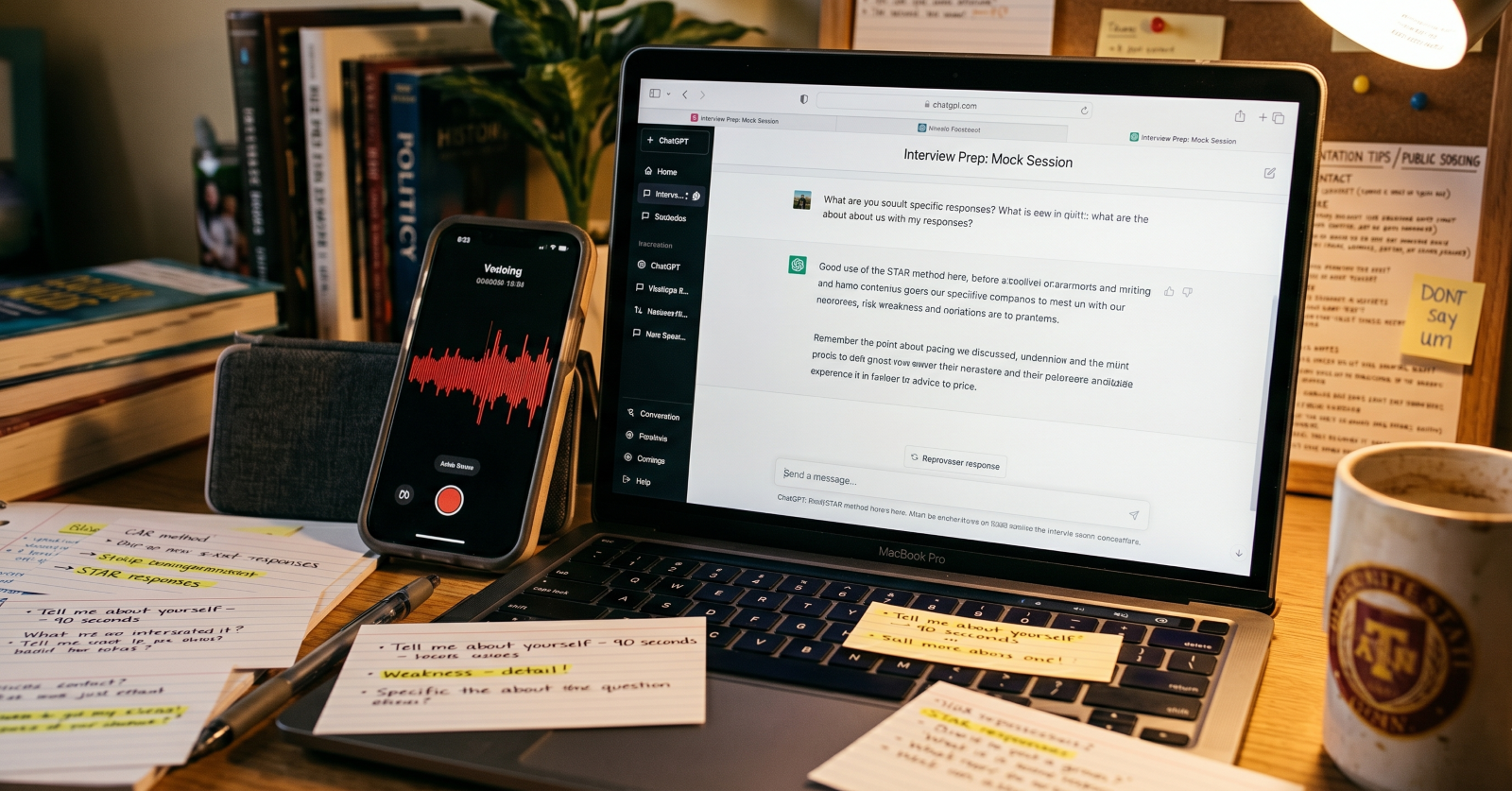
Free AI Phone Interview Practice Tool (ChatGPT Prompt)
This is the fastest way to practice when you don't have a career center appointment or a willing friend. Copy the prompt, upload your resume, answer out loud. If you've used our HireVue practice tool, this works the same way, adapted for phone format.
How to Use It
1. Open ChatGPT (free version works fine)
2. Upload your resume (PDF or DOCX)
3. Copy the simulation prompt below
4. Replace the brackets with your target company and position
5. Answer each question out loud. Don't type your answers. You won't type during a real phone call.
6. Get feedback after each response on structure, length, and content
Phone Interview Practice Simulation Prompt
I want you to simulate a phone interview for [Company Name] for a [Position Title, e.g., Summer Marketing Intern]. Please follow these rules exactly:

Format: Ask ONE question at a time. Wait for my response before asking the next question. This simulates a real phone call.

Interview Questions (6 total):

1. Tell me about yourself and what led you to apply for this role.

2. Why are you interested in [Company Name] specifically?

3. Tell me about a time you worked on a team project that didn't go as planned. What happened and what did you learn?

4. Describe a situation where you had to learn something new quickly. How did you approach it?

5. What are your salary expectations for this role? (If internship: What are you hoping to gain from this experience?)

6. Do you have any questions for me about the role or the team?

Feedback Rules (apply after EVERY response):

- Evaluate using the STAR method (Situation, Task, Action, Result) for behavioral answers
- FLAG if any answer exceeds 60 seconds of estimated speaking time (roughly 150 words). Phone answers must be concise.
- Check for filler words: flag excessive use of "um," "like," "you know," "basically," "honestly"
- Score three dimensions after each answer:
  1. Structure (1-5): Was the answer organized with a clear beginning, middle, end?
  2. Specificity (1-5): Did they use concrete examples, numbers, names?
  3. Phone Presence (1-5): Would this sound confident and clear on a phone call?
- Provide 2-3 specific improvement suggestions per answer
- Reference my uploaded resume when relevant — point out missed opportunities to connect experience to the question
- Tone = supportive career coach (direct, encouraging, practical)

After all 6 questions, provide:
- Overall phone interview grade (A/B/C/D)
- Top 3 strengths
- Top 3 areas to improve
- One specific thing to practice before the real call
What to Do Before, During, and After the Call
Your Pre-Call Checklist (30 Minutes Before)
Do all of this before the phone rings:
• Quiet room, door closed. Warn your roommates.
• Phone fully charged. Or a landline if you have one.
• Glass of water within reach
• Printed copy of your resume in front of you
• Your one-page cheat sheet (STAR stories, company facts, questions to ask)
• Pen and paper for taking notes during the call
• The interviewer's name and title pulled up on your screen
• A timer app open so you can self-monitor answer length
During the Call
Smile. Seriously. It sounds weird, but smiling changes your vocal tone. You'll sound warmer and more energetic even though no one can see you. Stand up or sit upright. Slouching flattens your voice.
Don't eat, chew gum, or drink anything loud. Save that glass of water for between questions.
And use the 2-second rule: after the interviewer finishes a question, pause for two beats before answering. It stops you from accidentally interrupting. A brief pause reads as thoughtful, not hesitant.
Take notes. Write down the key questions they ask and any details they share about the role. You'll need these for your thank-you email and for later rounds.
After the Call: Your Follow-Up Edge
Send a thank-you email within 24 hours. According to TopResume research, 68% of hiring managers say a thank-you email affects their decision. Yet only 24% of candidates actually send one.
That's a free competitive advantage. Don't leave it on the table.
Reference something specific from the conversation. Not "Thank you for your time," but "Thank you for explaining how the analytics team is restructuring. That confirmed this is exactly the kind of challenge I'm looking for."
For templates and full guidance, see our thank-you email after interview guide.
One more thing: write down every question you remember while the call is still fresh. If you advance, those notes prep you for round two. If you don't, they're practice data for next time.
Phone Interview FAQs
How long does a phone interview last?
Most phone interviews last 15-30 minutes. Recruiter screens are usually 15-20 minutes and focus on basic qualifications and logistics. Hiring manager calls run 20-30 minutes and go deeper into behavioral questions and role fit.
Is a phone screening the same as a phone interview?
Not exactly. A phone screen is shorter (10-15 minutes), run by a recruiter who's checking qualifications, salary expectations, and availability. A phone interview is longer, conducted by a hiring manager who evaluates your skills and cultural fit in more detail. Same phone, different stakes.
Can you use notes during a phone interview?
Yes. And you should. The biggest advantage of a phone interview over video or in-person is that the interviewer can't see your notes. Prepare a one-page cheat sheet with STAR stories, company facts, and questions to ask. Just don't read word-for-word. It sounds scripted.
How should you answer the phone for a phone interview?
Answer with a clear, confident greeting: "Hi, this is [Your Name]." Smile when you pick up because it changes your vocal tone. Be in your quiet space with your phone charged at least 10 minutes before the scheduled time.
What if you miss a phone interview call?
Call back within 5-10 minutes if you can. If you reach voicemail, leave a brief professional message and follow up with an email apologizing for the missed call and suggesting 2-3 alternative times. Most recruiters reschedule once without holding it against you.
Should you dress up for a phone interview?
You don't need a full suit. But dressing slightly above casual can shift your mindset and improve your vocal energy. Business casual helps you mentally switch into interview mode, even when nobody can see you.
How to follow up after a phone interview?
Send a thank-you email within 24 hours referencing something specific from the conversation. Keep it 3-4 sentences. If you haven't heard back after a week, send a brief check-in reaffirming your interest. For more resume and interview prep resources, check out our other guides.
About the Author
Bifei Wang has spent 17 years focused on human flow and the growth of young professionals, spanning international education, career training and coaching, and recruitment process outsourcing. Over 7 years at Extern, he has had one-on-one sessions with thousands of students exploring careers in consulting, finance, tech, marketing, and data, giving him a firsthand view of how the job market has shifted for early-career professionals and what it actually takes to break in.