
How Many Bullet Points Per Job on Resume? The Rules That Actually Matter
TL;DR
Three to five bullet points per job. That's the number, and it's not arbitrary. Recruiters spend roughly 6 seconds scanning your resume, so every single bullet needs to pull its weight with a specific result, skill, or achievement. Pad it with filler and they'll skim right past you.
• 3 to 5 bullet points per job is the standard, with your most recent role getting up to 6 if the experience is highly relevant
• Older or less relevant jobs should get 2 to 3 bullets maximum, or be condensed into a single-line entry
• Each bullet point should lead with an action verb and include at least one measurable result or specific outcome
• If you don't have enough bullet-worthy experience yet, Externships and project-based work can fill the gap fast
Externships are short, remote professional experience programs where you work on real projects with real companies. If your resume bullet points feel thin, an Externship gives you real deliverables to write about.
Here's what you need to know, when to break the rules, and what to do when you don't have enough experience to fill those bullets yet.

How Many Bullet Points Should You Put Per Job?
The standard is 3 to 5 bullet points per job, with your most recent role getting the most detail and older positions tapered down. This isn't some made-up rule. It's based on how recruiters actually read resumes.
The 3-to-5 Rule (and When to Break It)
Three to five bullets per job. That's the range that works. The Ladders eye-tracking study found recruiters spend an average of 6 to 7 seconds on an initial resume scan, which is barely enough time to read a text message. So if you pack each job with 8 or 9 bullets, most of them won't get read. Period.
Here's how to think about distribution:
• Most recent job: 4 to 5 bullets (stretch to 6 if the role is directly relevant to what you're applying for)
• Second most recent: 3 to 4 bullets
• Older stuff: 2 to 3 bullets, or just a single line with title, company, and dates
And here's the part people get wrong: the goal isn't to document everything you did at that job. It's to highlight the things that matter for the next one. If a bullet doesn't connect to the role you're targeting, cut it. Even if you're proud of it.
How Your Career Stage Changes the Number
Your career stage determines how many jobs show up on your resume, which changes how many bullets each one should get. Here's the quick breakdown:
| Career Stage | Experience | Positions on Resume | Bullets: Current/Recent Role | Bullets: Older Roles |
|---|---|---|---|---|
| Entry-level | 0–2 years | 1–3 positions | 4–5 bullets | 4–5 (all roles get full treatment; you need the space) |
| Mid-career | 3–7 years | 3–5 positions | 4–5 bullets | 2–3 bullets (taper older roles; drop irrelevant ones to 1 line) |
| Senior | 8+ years | 4–5 key roles | 3–4 bullets | 1–2 bullets or remove entirely |
The logic is straightforward: early in your career, you have fewer roles so each one needs more detail. As you gain experience, older positions earn less real estate because your recent work tells a stronger story. Entry-level candidates should also give full bullet treatment to Externships, volunteer work, and academic projects. Mid-career professionals should taper aggressively and drop anything irrelevant to a single line. And if you're senior? Nobody hiring a director cares about the coffee shop job from 2014.
What Makes a Resume Bullet Point Actually Good?
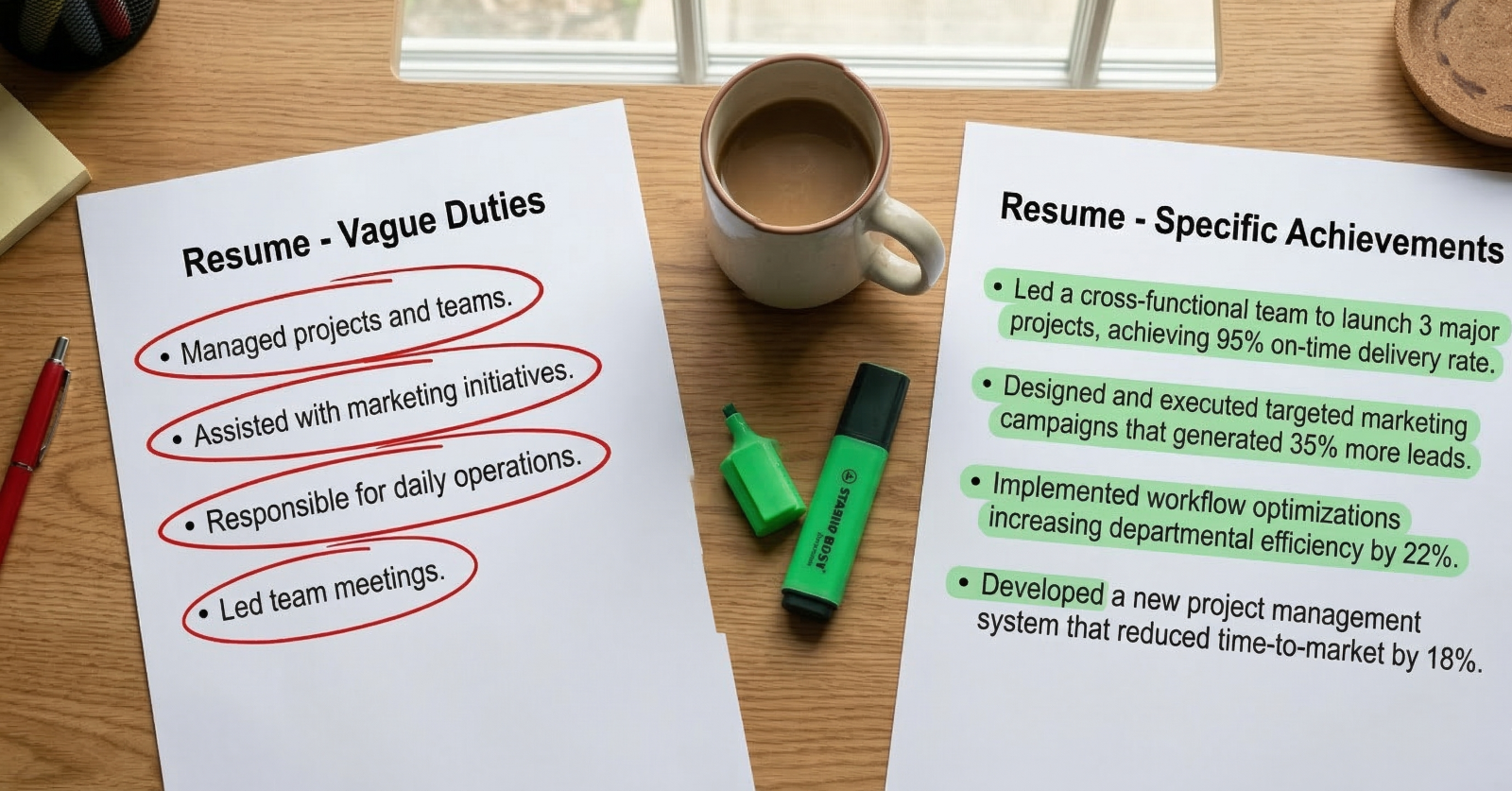
A strong bullet point starts with an action verb, describes what you did, and shows the result. That's it. Weak bullets describe duties. Strong bullets describe outcomes.
The Action Verb + Result Formula
Every bullet should follow a simple structure: action verb + what you did + what happened because of it. This formula works because it forces specificity, and specificity is what catches a recruiter's eye during those 6 seconds.
Weak: "Responsible for managing social media accounts"
Strong: "Grew Instagram following from 2,000 to 8,500 in four months by launching a weekly content series targeting college students"
See the difference? The weak version describes a duty anyone in that role would've had. The strong version describes an outcome that only you produced. One tells the recruiter what you were supposed to do. The other tells them what you actually pulled off.
When choosing verbs, pick ones that show ownership: led, built, designed, launched, analyzed, created, negotiated, implemented. Avoid vague or passive verbs like "assisted," "helped," or "participated in." And if you need inspiration for strong resume language, our skills to put on resume guide covers what hiring managers look for right now.
How to Quantify Results When You Don't Have Numbers
Not every accomplishment comes with a dollar figure attached. That's fine. You can still show scale using other measures:
• Team size: "Led a team of 5 to complete..."
• Timeframe: "Delivered the project two weeks ahead of deadline"
• Scope: "Managed a database of 3,000+ student records"
• Frequency: "Wrote and published 12 blog posts per month"
• Scale: "Coordinated logistics for a 200-person campus event"
You don't need perfect numbers. You need enough context so the reader can picture what you actually did, not just read your job title and fill in the blanks themselves.
How Do You Decide Which Bullet Points to Keep?
Keep bullets that match the job you're applying for and cut anything that describes a generic duty without clear impact. Every bullet has to earn its spot on the page.
Match Your Bullets to the Job Description
Here's something a lot of applicants skip entirely: tailoring bullet points to each job posting. About 97.8% of Fortune 500 companies use applicant tracking systems to filter resumes before a human ever reads them. These systems scan for keywords from the job description. If the posting says "data analysis" and your resume says "number crunching," the ATS might not connect the dots.
So read the posting carefully. Pull out the top 5 to 8 skills it mentions. Then adjust your bullets to mirror that language. You don't need to rewrite everything for every application, but swapping a few verbs and adding relevant keywords makes a measurable difference.
Your LinkedIn profile should follow the same logic, by the way. If your resume and LinkedIn tell the same story using the same language as the job posting, recruiters notice.
Cut Bullets That Don't Show Impact
If a bullet describes something anyone in that role would've done, it's probably not pulling its weight. "Answered customer phone calls" tells a recruiter nothing about you specifically. "Resolved an average of 45 customer inquiries per shift, maintaining a 95% satisfaction rating" does.
Ask yourself for each bullet: does this show something I accomplished, or does it just describe a task I was assigned? If it's the second one, rewrite it with a result or replace it.
What If You Don't Have Enough Bullet Points?
If you can't fill 3 to 5 bullets per job, the fix is usually reframing your existing experience or building new resume-ready experience through projects, Externships, and strategic volunteering. The issue usually isn't that you haven't done anything. It's that you haven't framed it right.
Turn Class Projects and Side Work Into Resume Bullets
You don't need a corporate job to have bullet-worthy experience. Class projects, volunteer gigs, campus organizations, and part-time work all count if you apply the action verb + result formula.
Some examples of how to reframe common experiences:
• Class project: "Developed a market analysis for a local nonprofit as part of a capstone team, presenting findings to the client's board of directors"
• Volunteer role: "Organized a campus fundraiser that raised $2,000 for local food banks over a two-week campaign"
• Part-time job: "Trained 3 new team members on POS system and closing procedures, reducing onboarding time by 30%"
Glassdoor data shows entry-level positions receive 250+ applications on average. Your resume needs substance, not filler. And if you need more guidance on building a resume from scratch, our resume with no experience guide walks through the whole thing.
Build Real Experience With Externships
But what if you've genuinely run out of things to put on your resume? That's not a formatting problem. That's an experience problem, and the solution is to build more of it. Externships solve this directly. They're structured, remote professional experience programs where you complete real projects for established companies.
Recent externs have worked with TikTok, Pfizer, and News Corp. Not hypothetical case studies. Real deliverables with real company names that become specific, quantifiable bullet points:
• "Developed a content strategy framework for TikTok's brand partnerships team"
• "Analyzed supply chain data for Pfizer, identifying 3 process optimization opportunities"
That's the kind of material that turns a thin experience section into one that competes. You can also check out best websites to find internships for more paths to building experience.

What Are the Most Common Bullet Point Mistakes?
Two big ones: writing mini-paragraphs instead of actual bullets, and starting every single line with the same verb. Both are fixable in about ten minutes.
Writing Paragraphs Instead of Bullets
Each bullet should be one to two lines. Fifteen to twenty-five words. If it wraps to three lines on a standard resume template, it's too long. Split it into two bullets or cut the weaker details.
Recruiters process resumes in seconds, not minutes. Dense text blocks signal "this person can't communicate concisely," which is basically the opposite of what you want. White space is your friend here. Short, punchy bullets with clear results beat paragraph-length descriptions every time.
Starting Every Bullet the Same Way
Reading five bullets in a row that all start with "Managed..." is like reading a grocery list. It's technically informative but boring enough that a recruiter will stop halfway through.
So mix up your verbs intentionally. If your first bullet starts with "Led," follow it with "Designed," then "Analyzed," then "Built." Here's a quick swap list:
• Instead of "Managed" try Led, Directed, Coordinated, Oversaw
• Instead of "Helped" try Contributed to, Supported, Enabled, Strengthened
• Instead of "Worked on" try Built, Developed, Engineered, Produced
And if you've been ghosted after interviews, your resume formatting might actually be part of the problem. These small details add up more than most people realize.
Should Your Resume Be One Page or Two?
For most students, recent grads, and early-career professionals, one page. Two pages only make sense when you've got 10+ years of relevant experience.
The number of bullets per job is the single biggest factor controlling your resume's length. If you're hitting two pages as an entry-level applicant, you almost certainly have too many bullets per job, too many jobs listed, or both. Go back through each position and honestly ask: does this bullet earn its spot?
A clean one-page resume with 3 to 5 strong bullets per job will outperform a bloated two-pager with 8 bullets of padding every single time. Quality over quantity. Always.
FAQs
How many bullet points per job on a resume is too many?
More than 6 is almost always too many. Recruiters spend roughly 6 seconds on an initial scan, and long bullet lists just make them skim faster. Stick to 3 to 5 bullets for recent roles and cut older positions down to 2 or 3 that highlight your strongest contributions and most relevant results.
Should I use bullet points or paragraphs on my resume?
Bullets. Every time. Paragraphs are harder to scan, and recruiters skip dense text blocks instinctively. Each bullet should be one to two lines with a clear action verb at the start and a specific result in the body. If it reads like a sentence from an essay, it's too long.
What is the best action verb to start a resume bullet point?
It depends on what you did, but strong picks include led, designed, built, analyzed, managed, created, and implemented. Stay away from passive verbs like "assisted" or "helped" when something more specific works. And vary your verbs across bullets so the whole section doesn't feel like it was written by a bot.
How do I write resume bullet points with no experience?
Pull from class projects, volunteer work, part-time jobs, and campus organizations. Frame each bullet with an action verb and a specific outcome. "Organized a campus fundraiser that raised $2,000 for local food banks" is a completely valid bullet point, even without traditional work experience to draw from.
Do I need to include every job I've ever had on my resume?
No. Only include positions that are relevant to what you're applying for or that show transferable skills. For early-career applicants, 2 to 3 positions is usually enough. Older or irrelevant jobs can be dropped entirely or condensed into a single line with no bullet points underneath.
How long should each bullet point be on a resume?
One to two lines, roughly 15 to 25 words. If a bullet wraps to three lines, it's too long and needs to be split or trimmed. Concise bullets with specific, measurable results always perform better than lengthy descriptions that try to cover everything you did in a role.
About the Author
Bifei Wang has spent 17 years focused on human flow and the growth of young professionals, spanning international education, career training and coaching, and recruitment process outsourcing. Over 7 years at Extern, he has had one-on-one sessions with thousands of students exploring careers in consulting, finance, tech, marketing, and data, giving him a firsthand view of how the job market has shifted for early-career professionals and what it actually takes to break in.