

You finished your degree. You opened a job board. You typed "entry level."
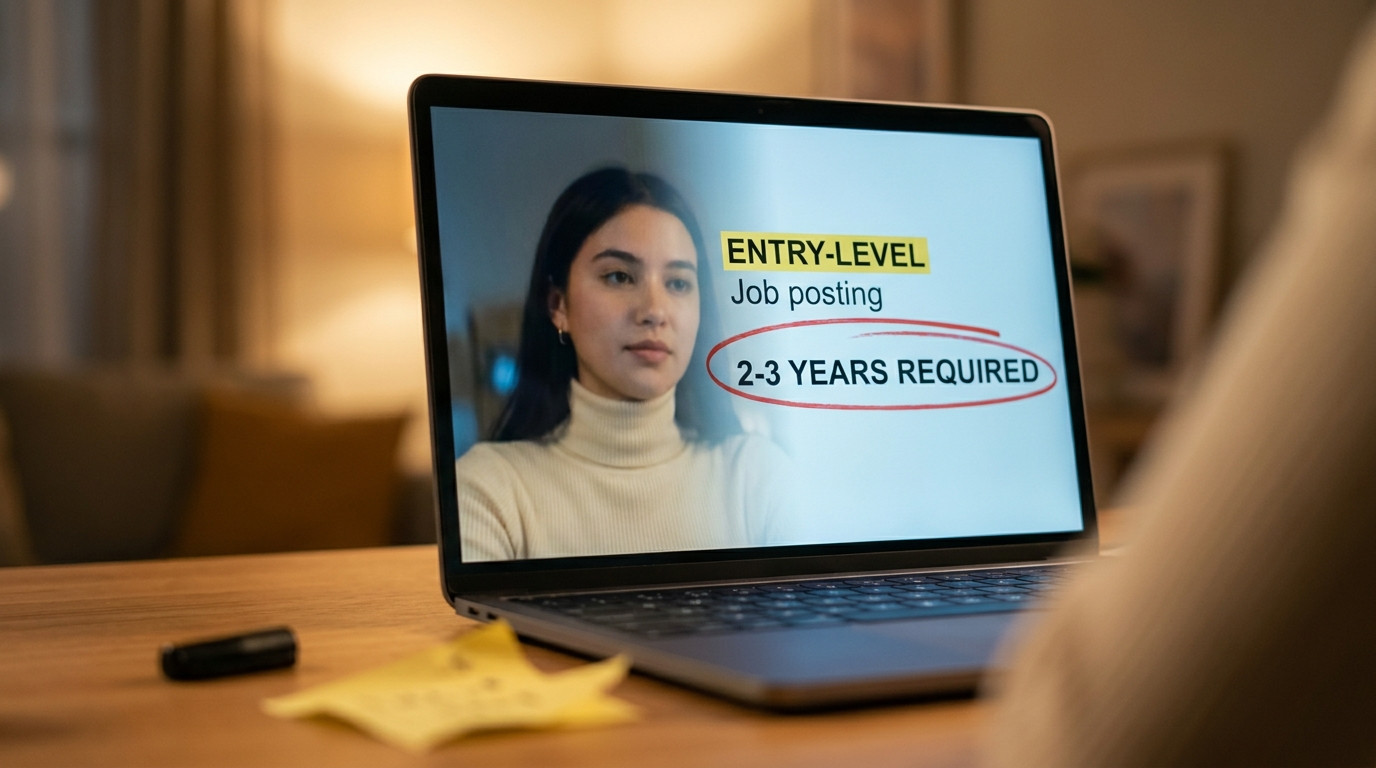
And then the first three listings all asked for "2-3 years of experience required." Cool.
If you thought how is that even entry-level?, you're not making it up. About 35% of jobs labeled "entry-level" now require three or more years of experience. That number keeps climbing. So why do entry level jobs require experience in the first place, and what can you actually do about it?
Here's the real story behind the paradox, plus five concrete ways to qualify even when your resume feels painfully thin.
Want to build experience hiring managers care about? Explore Externships at Extern and start a real project with a company in weeks.
TL;DR
• Employers list experience on entry-level postings to cut training costs, filter massive applicant pools, and find people who can contribute fast. Roughly 35% of "entry-level" postings ask for 3+ years.
• "Entry-level" doesn't mean "no skills needed." It means the lowest rung at the company, and they still want proof you can handle the work.
• You've probably got more qualifying experience than you realize. Coursework, volunteer roles, freelance gigs, and remote Externships all count when you frame them around skills and results.
• Fastest way to close the gap: do a short, project-based professional experience and walk away with a portfolio piece and a reference you can actually use.
Externships are short, remote professional experience programs where you work on real projects with real companies. Explore all Externships.
What Does "Entry-Level" Really Mean in 2026?
The textbook definition vs. what hiring managers actually mean
An entry-level job is the lowest-tier position in a company's hierarchy for a given function. That's the textbook answer.
Twenty years ago, it also meant companies expected to train you from zero. They'd hire for potential, teach the tools, and give you months to ramp up. That version of entry-level is mostly dead. Today, "entry-level" means the least senior seat on the team. But employers still expect you to walk in with some proof you can handle the work. Think of it as "least experience required," not "no experience needed." The label stayed the same. The expectations behind it shifted completely. And that mismatch is where most of the confusion lives.
Why "0-2 years" became the new floor
When a posting says "0-2 years of experience," it doesn't mean two years on someone's payroll. Most hiring managers read this loosely. Internships count. Externships count. Research projects, freelance gigs, relevant coursework, structured volunteer work. All of it can fill this window.
But here's the problem. About 35% of entry-level postings now ask for three or more years. That's not 0-2. That's a mid-level job wearing an entry-level price tag. And if you've been feeling like the math doesn't add up? It genuinely doesn't.
Why Do Entry-Level Jobs Require Experience? (4 Real Reasons)
It's not one thing. Four forces are pushing in the same direction at once.
Reason 1: They're trying to reduce hiring risk
Every new hire is a gamble. SHRM puts the average cost per hire at nearly $4,700, and that's before any training starts. ATD's research shows companies spend another $1,280 per employee per year on development.
So when someone's already done similar work before, the company's risk drops. From their side of the table, it makes sense. You've proven you can handle the pressure of deadlines, collaborate with a team, and produce work that meets professional standards. That's what they're really screening for. It doesn't make the frustration any less real, but understanding the "why" helps you figure out the "how."
Reason 2: Too many applications, not enough time
We kind of did this to ourselves. Online job boards made applying so easy that a single entry-level posting now pulls 250+ applications on average, with popular roles hitting 400 or more. When a hiring team is staring at 400 resumes? "Years of experience" becomes the fastest way to shrink the pile. It's not personal. It's triage.
Reason 3: Somebody copy-pasted the wrong job description
Here's a less dramatic but shockingly common reason. Many HR teams recycle job descriptions from mid-level roles without touching the requirements. The posting gets labeled "entry-level" because that's how the budget works, but nobody bothers to update the experience section.
The result? A junior role that reads like it wants a senior applicant. Nobody tracks how often this happens, but if you've ever seen a posting for an "entry-level coordinator" that lists five years of experience and fluency in three software platforms, this is probably what happened. Not malice. Just inertia.
Reason 4: "Entry-level" just means "entry-level pay"
Some companies use "entry-level" to describe the compensation bracket, not the skill bracket. They want mid-level output at junior pricing. Zippia's analysis of thousands of job postings found this pattern across industries, and tech and finance were the worst offenders.
When a posting says "entry-level" but requires Python, SQL, and Tableau for a $65K role? They're not confused. They're budgeting.
How Are You Supposed to Get Experience When Every Job Requires It?
The catch-22 is real. But it's not as stuck as it feels.
You need experience to get hired. You need to get hired to get experience. That loop is real, and the frustration is valid.
But here's what the numbers say. Robert Half found that 84% of companies are open to hiring candidates whose skills can be developed through training. Same survey: 42% of resumes companies receive come from people who don't meet all the listed requirements.

So those "requirements"? Mostly wish lists. Companies write the ideal candidate, then regularly hire someone who matches 60-70% of it. That's not a guess. That's how hiring works in practice.
What actually counts as "experience" (it's more than you think)
Hiring managers care about proof of capability. Not years on a clock. Here's what they'll accept:
• Internships and project-based programs, even short or remote ones
• Freelance or contract work (you designed a friend's website? That's UX experience)
• Academic projects with real deliverables, like research papers, data analysis, or marketing campaigns
• Volunteer roles where you led, organized, or built something tangible
• Part-time jobs with transferable skills (managed inventory, trained new hires, handled customer escalations)
The trick is framing. Don't list responsibilities. List results. Not "helped with social media" but "grew Instagram engagement 40% in one semester." That one shift changes how a hiring manager reads your resume.
How to Qualify for Entry-Level Jobs Without Traditional Experience
Do a remote Externship and build proof fast
If your resume has a blank where professional experience should go, this is the most direct fix. A remote Externship puts you on a real project with an actual company for 6-12 weeks. You work remotely. You get a portfolio piece, a professional reference, and a resume line that says more than "seeking opportunities."
And unlike a traditional internship, you don't need prior experience to start one. These programs were built for exactly this situation: students and early-career people who need their first real credential.
Reframe what you've already done
Most students undervalue themselves here. Tutoring? That's communication and breaking down complex ideas for different audiences. Running a campus club's budget? Financial management. Coordinating a group project across four time zones? Project management.
Try this: open a blank doc and list every structured thing you've done in the past two years. Then translate each one into the language you see on job postings. You'll probably surprise yourself. For a full walkthrough, this transferable skills guide breaks it down step by step.
Stop mass-applying. Start targeting.
Sending 200 applications into the void doesn't work when you're competing against 400 other applicants per posting. The math is brutal. Instead, pick 10-15 companies where you can stand out. Research the team. Connect with someone on LinkedIn. Mention a specific project the company launched recently.
One well-researched application will outperform twenty generic ones. Almost every time. Is it slower? Yes. Does it feel less productive? Probably. But the conversion rate is dramatically better, and that's what actually gets you hired.
Address the experience gap in your cover letter
Don't pretend the gap isn't there. Name it, then pivot. Something like: "I don't have three years of full-time marketing experience. But I do have a completed Externship with [Company], a content strategy I built for my capstone, and a portfolio showing what I can deliver."
That kind of honesty paired with real evidence is more compelling than pretending the gap doesn't exist. Hiring managers know you're early in your career. What they want to see is that you've thought about it and taken action anyway.
Build a small portfolio or project showcase
For fields like marketing, design, data, and tech, two or three solid projects can matter more than years of experience. Spin up a simple portfolio site or a public GitHub repo. Show what you built, the tools you used, and the outcome. Projects from structured professional programs work especially well here because they come with real company context, not hypothetical classroom scenarios.

Your resume doesn't need years. It needs proof. Start an Externship and build the professional experience that gets you past the filter.
FAQ: Entry-Level Jobs and Experience Requirements
Do entry-level jobs actually require experience?
Many list it as preferred, not mandatory. About 35% of entry-level postings ask for 3+ years, but 84% of companies say they're willing to train candidates who don't check every box. If you can show capability through projects, coursework, or short-term professional experiences, you're a real candidate.
How many years of experience do you need for an entry-level job?
Most expect 0-2 years. That includes internships, project-based programs, freelance work, and academic projects. If a posting says "1-2 years preferred," they want evidence of capability. Not necessarily years on a payroll.
Why do all jobs seem to require experience now?
Three things happened at once: online applications flooded hiring pipelines (250+ per posting is normal now), HR teams started copy-pasting job descriptions from higher-level roles, and companies began using "entry-level" to mean "entry-level pay" rather than "entry-level skill." The result is inflated requirements everywhere.
What jobs actually require no experience?
Customer service, retail, food service, and admin support roles frequently hire with zero experience. For professional entry-level work in finance, tech, or marketing, project-based professional experiences can stand in for traditional job history and help you build your first resume.
How do I get experience when no one will hire me?
Start with what you can control. Join a short professional project or program. Volunteer for something that aligns with your target field. Build a portfolio project. Freelance a skill you already have. Any of these creates resume-ready proof. That's what breaks the cycle.
Are entry-level jobs only for recent graduates?
No. They're open to career changers, people re-entering the workforce, and anyone new to a specific industry. "Entry" describes the position's level within the company, not your age or how recently you graduated.
Your Move
The entry-level experience paradox isn't going anywhere. Volume, cost, and risk will keep pushing companies to list requirements that feel out of reach. But the data says they keep hiring people who don't meet every bullet point.
You don't need to match a checklist. You need proof you can do the work. And that proof doesn't have to come from three years at a desk. It can come from a six-week Externship, a freelance project, or a portfolio you built on your own.
The gap between "no experience" and "enough experience" is smaller than most job postings make it look. A single completed project, one good reference, a portfolio with three pieces of real work. That's often enough to move from "auto-reject" to "let's talk."
Close the gap with action. Not more scrolling.
About the Author
Bifei Wang has spent 17 years focused on human flow and the growth of young professionals, spanning international education, career training and coaching, and recruitment process outsourcing. Over 7 years at Extern, he has had one-on-one sessions with thousands of students exploring careers in consulting, finance, tech, marketing, and data, giving him a firsthand view of how the job market has shifted for early-career professionals and what it actually takes to break in.