Outamation logoCurrently an Extern @Outamation
Zainab Khan portrait

I build thoughtful products that make complex systems feel simple.

I combine software engineering, product thinking, and design to build clear, human-centered experiences—from AI systems and real-time platforms to tools that strengthen local communities.

Works samples

I build software, AI tools, and digital products for real people and organizations, driven by complex problems that can be made simpler.

  • Outamation Advanced AI-Powered Document Insights and Data Extraction Externship
    Outamation Advanced AI-Powered Document Insights and Data Extraction Externship
    Outamation logo

    Outamation · Jul 2026 · ✅ Verified by Extern

    Outamation Advanced AI-Powered Document Insights and Data Extraction Externship

    Think AI is all about chatbots and image generators? Think again. In this externship, explore how AI is transforming massive, messy document workflows into smart, searchable data. From building Python scripts to testing open-source models, turn unstructured files into usable insights.

    AI & MLData AnalysisPythonGoogle ColabPresentation SkillsLlamaIndex
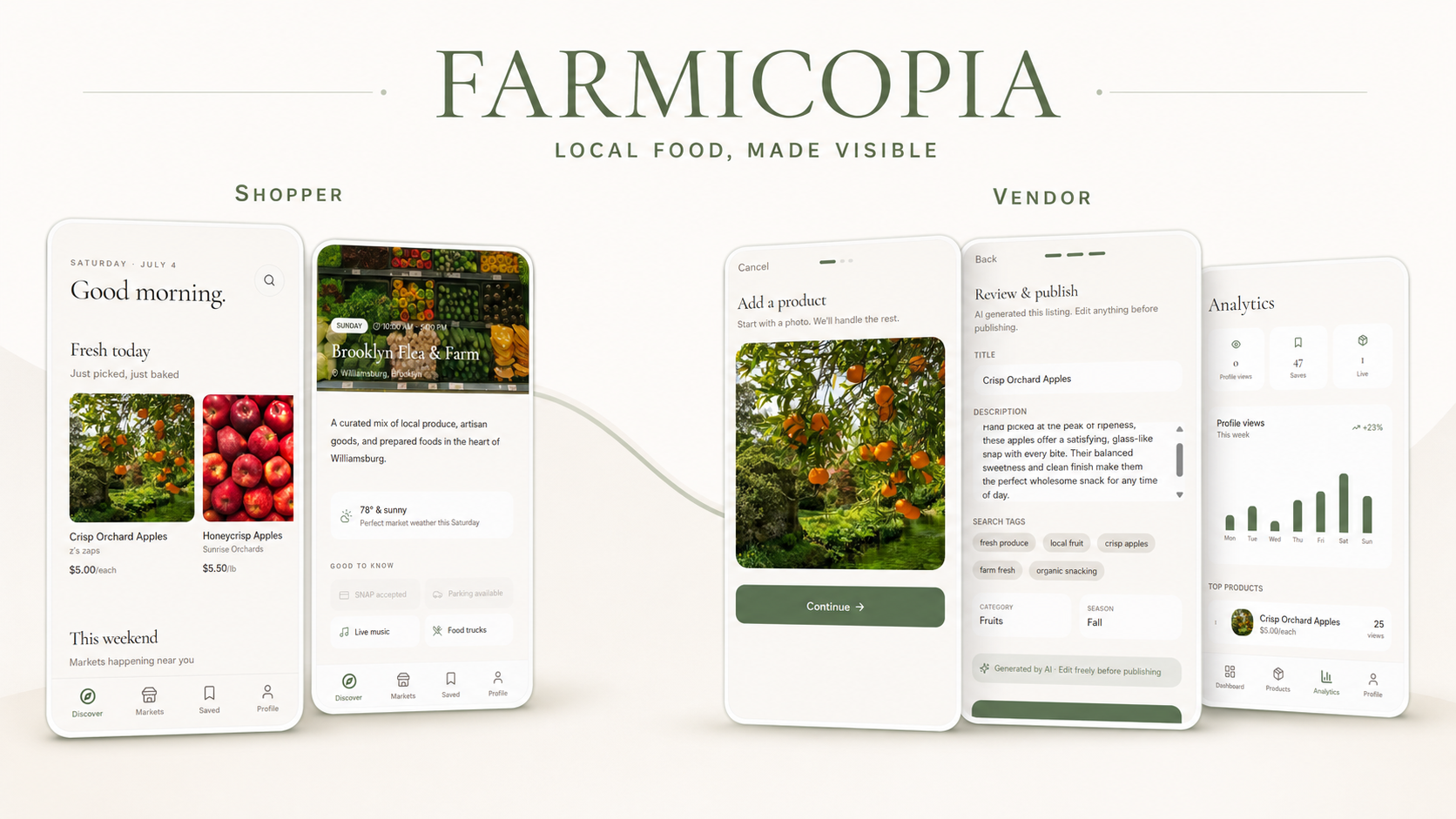
  • Farmicopia – Farmers Market Marketplace
    Farmicopia – Farmers Market Marketplace

    Hackathon Finalist · Jan 2026

    Farmicopia – Farmers Market Marketplace

    Farmicopia is a farmers market marketplace that helps shoppers discover local vendors and available products. Built from 50+ surveys and seven stakeholder interviews, it uses vendor profiles, live listings, and AI-assisted descriptions to improve visibility and reduce unsold inventory.

    FirebaseProduct StrategyUser ResearchMVP PrioritizationFigmaReactData ModelingAI IntegrationGitHubTeam Leadership

About me

I combine software engineering, product thinking, and design to build clear, human-centered experiences—from AI systems and real-time platforms to tools that strengthen local communities.

I'm a junior at the University of Washington pursuing a Bachelor's Degree. I'm currently enhancing my skills and gaining practical experience through an externship at Outamation, where I'm working with AI to transform document workflows into actionable insights.

Externships

Outamation Advanced AI-Powered Document Insights and Data Extraction Externship

Outamation

Experience

Software Engineer Intern

Palana · Jun 2026 - Present

AI Technology Intern, Data Analytics – Commerce Team

GoDaddy · Jun 2025 – Sep 2025

Education

University of Washington, Information School

B.S. Informatics – Software Development & Human-Computer Interaction | Minor: Data Science | GPA: 3.6 · Class of 2027

Skills

PythonAIData ExtractionDocument Insights
Back to works

Outamation Advanced AI-Powered Document Insights and Data Extraction Externship

Think AI is all about chatbots and image generators? Think again. In this externship, explore how AI is transforming massive, messy document workflows into smart, searchable data. From building Python scripts to testing open-source models, turn unstructured files into usable insights.

AI & MLData AnalysisPythonGoogle ColabPresentation SkillsLlamaIndex
Outamation Advanced AI-Powered Document Insights and Data Extraction Externship
Outamation logo

Overview

In the Outamation Advanced AI-Powered Document Insights and Data Extraction Externship, I explored how AI revolutionizes document workflows. I developed Python scripts and tested open-source models to transform unstructured documents into actionable insights, gaining skills that are highly valued by employers. My projects focused on improving document processing, especially in the mortgage

What I did

Throughout this externship, I engaged in multiple projects that deepened my understanding of AI technologies and their applications in document processing. Below are the key tasks I completed during this experience:

1

Project 1: How AI Reads and Understands Mortgage Documents

I examined how AI comprehends mortgage documents by studying Machine Learning, Deep Learning, LLMs, and NLP. I also investigated Computer Vision and OCR techniques for extracting information from scanned documents, addressing challenges in the mortgage industry and emphasizing the need for accurate

3

Project 3: Data Extraction from Documents Using Python

Before AI can make sense of documents, it needs clean, structured data. In this project, you’ll learn how to turn both digital and scanned PDFs into machine-readable formats using Python. You’ll explore tools like PyMuPDF and pdfplumber to extract text from multi-page mortgage files. Then, you’ll apply field heuristics—like regex patterns, anchor phrases, and layout clues—to identify key fields such as borrower name, salary, and loan amount.

5

Project 5: Introduction to Retrieval-Augmented Generation (RAG)

AI models can process vast amounts of text, but finding the right information quickly is a challenge. In this project, you’ll learn how to build a Retrieval-Augmented Generation (RAG) pipeline using LlamaIndex to help AI retrieve relevant data from large document sets.

7

Project 7: Blob Processing, Classification, and Routing

Mortgage files often come as massive, unstructured "blobs" that include dozens of document types in a single PDF. In this project, you’ll design a system to split unstructured blobs into individual documents, classify each one, and route them to the appropriate extraction logic. You’ll use layout-based clues and rule-based methods—or even simple machine learning—to separate and identify documents like pay slips, IDs, and contracts. Then, you’ll build a routing function to apply the right extraction pipeline for each document type. By the end, you’ll have created a modular, intelligent system that mirrors real-world document workflows in mortgage automation.

9

Project 9: Final Integration, Testing, and Evaluation

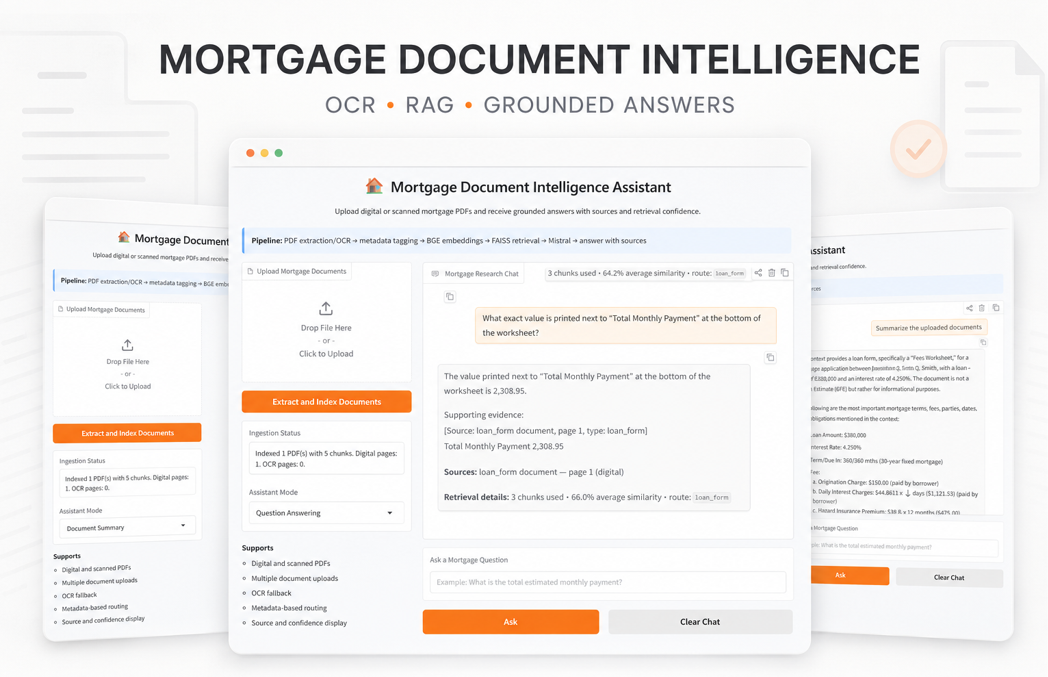
It’s time to bring everything together. In this final project, you’ll integrate all components into a complete, end-to-end document intelligence system. You’ll run your pipeline on a full mortgage blob, from preprocessing and OCR to extraction, RAG retrieval, and user interaction. Then, you’ll rigorously test the system’s performance, evaluating accuracy, speed, and reliability across different document types. Finally, you’ll package your work into a clear, professional demo—including a Colab repo, documentation, and walkthrough video—that showcases your system’s real-world potential. By the end, you’ll have a fully functional AI-powered document automation platform ready to present to peers, mentors, or even hiring managers.

2

Project 2: Learn to Work with Python for AI-Powered Document Processing

I utilized Python for data processing, focusing on cleaning and organizing mortgage documents to prepare them for AI automation. I explored Google Colab, learned Python basics, and implemented data preparation techniques that enhanced the accuracy of Optical Character Recognition (OCR) for mortgage

4

Project 4: Advanced OCR Comparison and Layout-Aware Extraction

OCR (Optical Character Recognition) is at the heart of document intelligence. In this project, you’ll get hands-on with three OCR engines— Tesseract, PaddleOCR, and EasyOCR —to see how they perform on complex mortgage documents. You’ll start by learning how to clean and extract text from scanned PDFs using Tesseract. Then, you’ll explore layout-aware tools that better preserve formatting and structure. Finally, you’ll run comparisons and recommend the most effective tool for real-world automation. By the end, you’ll be able to confidently select and justify OCR tools based on both technical and business needs.

6

Project 6: Advanced RAG and Open-Source Experiments

In this project, you’ll take your RAG pipeline to the next level by improving precision and experimenting with open-source LLMs. First, you’ll explore advanced chunking techniques—like overlapping and tuning—to improve document segmentation. Then, you’ll implement metadata-based filtering so your system retrieves more contextually relevant answers. You’ll also evaluate the performance of open-source models like Mistral and Phi-2 compared to proprietary options. By the end, you’ll have a fine-tuned, high-performing RAG pipeline optimized for real-world mortgage documents and the ability to justify your design decisions based on retrieval accuracy and model efficiency.

8

Project 8: Gradio Chatbot with RAG Integration

I created an interactive chatbot integrated with my RAG pipeline using Gradio. This allowed users to query documents through a web-based interface, modularizing the pipeline and facilitating easy integration of various language models for enhanced user interaction.

View all works
Back to works

Farmicopia – Farmers Market Marketplace

Farmicopia is a farmers market marketplace that helps shoppers discover local vendors and available products. Built from 50+ surveys and seven stakeholder interviews, it uses vendor profiles, live listings, and AI-assisted descriptions to improve visibility and reduce unsold inventory.

FirebaseProduct StrategyUser ResearchMVP PrioritizationFigmaReactData ModelingAI IntegrationGitHubTeam Leadership
Farmicopia – Farmers Market Marketplace

Overview

Farmicopia is a farmers market marketplace that helps shoppers discover local vendors and available products. Built from 50+ surveys and seven stakeholder interviews, it uses vendor profiles, live listings, and AI-assisted descriptions to improve visibility and reduce unsold inventory.

What I did

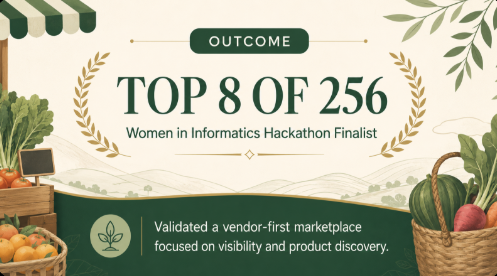
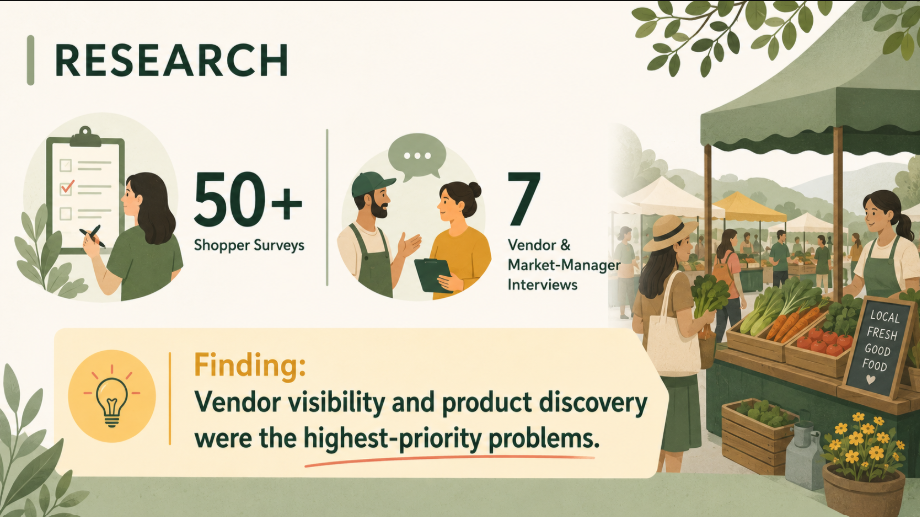
Led customer research, product direction, MVP scoping, and technical planning for a marketplace connecting farmers market vendors with local shoppers. I translated 50+ shopper surveys and seven vendor and market-manager interviews into product requirements, designed the experience in Figma, and contributed to the React and Firebase implementation. I also designed an AI-assisted workflow that generates searchable product titles and descriptions from vendor photos and limited information. Our research identified vendor visibility and product discovery as the most urgent problems, leading us to pivot from a broad market-management platform to a focused vendor marketplace. Farmicopia was selected as a Women in Informatics Hackathon finalist, placing in the top 8 out of 256 participants.

Farmicopia – Farmers Market Marketplace What I did image 1
Farmicopia – Farmers Market Marketplace What I did image 2
View all works
Back to works

Foundry — Mentorship for Small-Business Founders

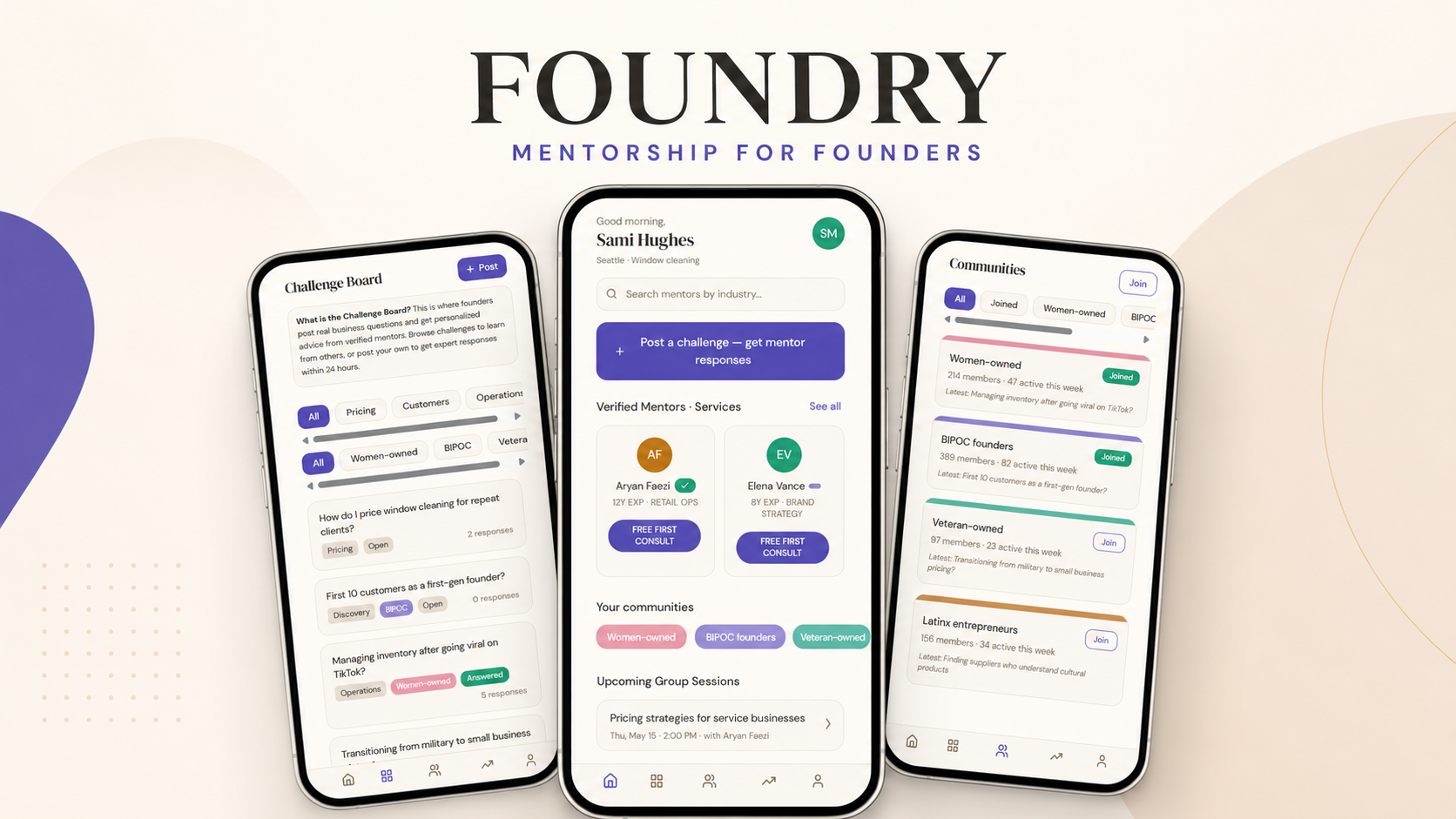
Foundry is a mentorship platform connecting small-business founders with experienced owners. Designed to support women, BIPOC, and other underrepresented entrepreneurs, it offers verified mentors, founder communities, paid sessions, and a free first consultation.

ReactViteKroger APIGoogle Maps APISpoonacular APIUX ResearchStakeholder InterviewsUI DesignPrototypingUsability Testing
Foundry — Mentorship for Small-Business Founders

Overview

Foundry is a mentorship platform connecting small-business founders with experienced owners. Designed to support women, BIPOC, and other underrepresented entrepreneurs, it offers verified mentors, founder communities, paid sessions, and a free first consultation.

What I did

I led the project’s research and design process, interviewing local business owners and domain experts to understand barriers to accessing trustworthy mentorship. I translated the findings into problem statements, product requirements, user flows, and feature priorities. I also created the complete UI, developed the interactive prototype, and iterated on the experience using feedback. Foundry was selected as one of the top two projects in the class following presentations evaluated by industry professionals, including employees from UW, Google and Microsoft. The final prototype demonstrated a validated, accessible approach to connecting diverse founders with credible business mentorship.

View all works